A day in a Montessori classroom
For readers aged 6 to 9. If you are 3 to 6, read it together with an adult.
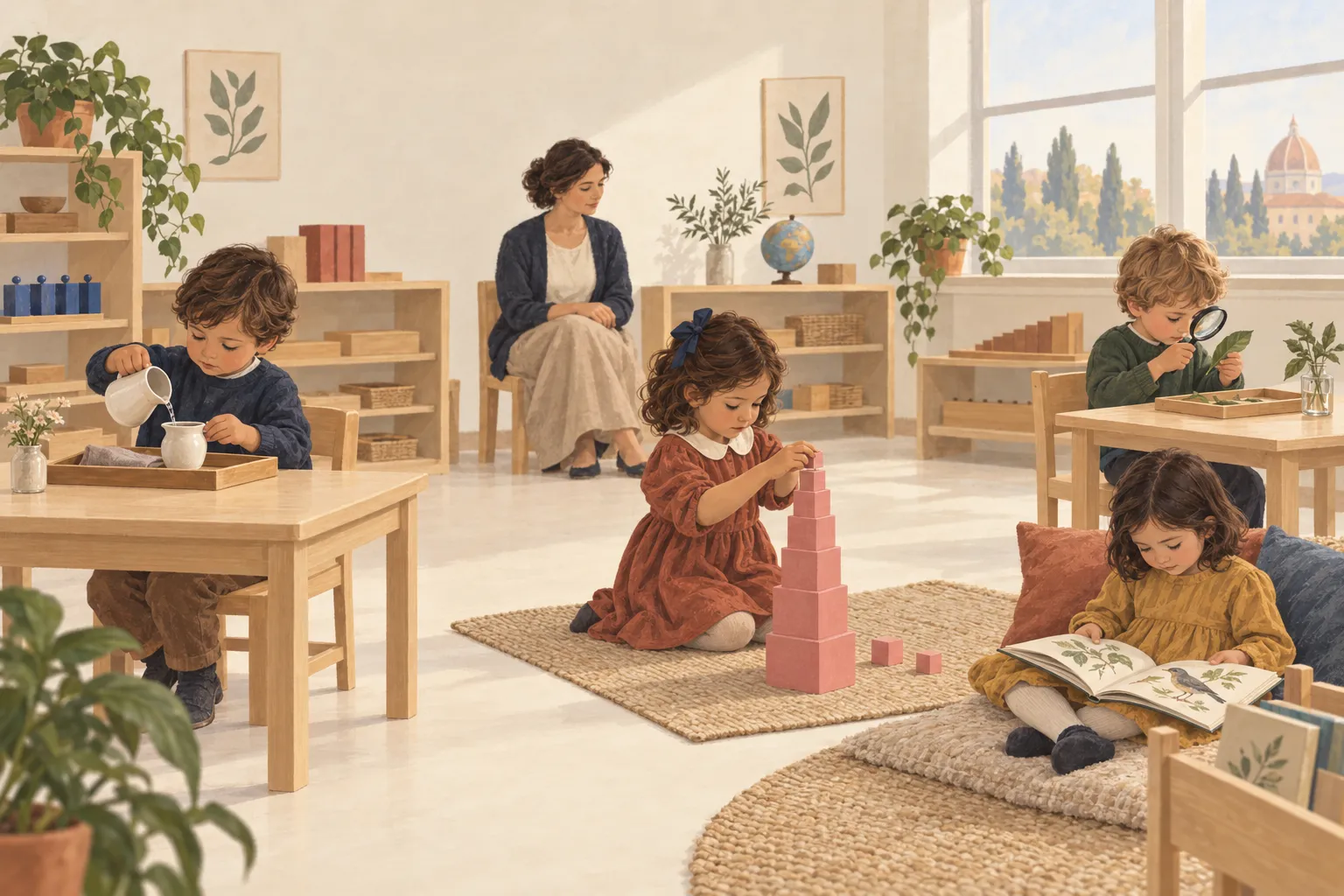
Montessori classrooms are not all the same, so the one you visit might look a little different. But if you’ve never been in one, here’s what you might notice that’s different from what you expected.
Nobody is doing the same thing at the same time
Walk in, and you probably won’t see every child sitting at a desk doing the same page of the same book. You’ll see one child carefully pouring water from one jug to another. Another building a tower out of blocks that get smaller and smaller. Another tracing a letter shape with their finger. Another reading, alone, on a rug on the floor. Everyone chose their own work from a shelf of things they’re allowed to use, and almost nobody is being told what to do right now.
Children of different ages are in the same room
Unlike a lot of schools, a Montessori classroom usually has children of several different ages together. Maybe six-year-olds and eight-year-olds in the same room, or three-year-olds and five-year-olds. The older children often end up helping the younger ones, and the grown-ups usually let that happen on purpose. In Montessori’s approach, the idea is that showing someone else how to do something can help you understand it even better yourself.
Grown-ups mostly watch
The adult in the room is often called a “guide” rather than “teacher”. They spend a lot of time quietly watching, not talking. When they do step in, it’s often to show one child, once and slowly, how to use something new. Then they step back and let that child try it themselves, even if they get it wrong at first.
There’s a long stretch of time to work, uninterrupted
Usually, nobody rings a bell every 40 minutes to make everyone switch to something different. Many Montessori classrooms protect a long block of time, often a few hours, where children can stay with one thing for as long as they want, or try a few different things in whatever order they choose.
Everything has a place, and children put it back themselves
Shelves are usually low enough for children to reach by themselves, and each thing on the shelf has one spot it belongs. Part of using something is putting it back exactly where it came from when you’re finished, because that’s part of how the room works.
It can look messy and quiet at the same time
The room is rarely silent. You’ll hear talking, movement, the occasional dropped object. But it’s usually not loud or chaotic either. A lot of adults who visit for the first time say it feels calmer than they expected, even though children are moving around and choosing their own activities the whole time.
A note for grown-ups: this is an original, simplified description for young readers, not a reproduction of any school’s specific handbook or any published curriculum text. Classrooms differ between schools and between Montessori training traditions, so it describes common features, not a rule every Montessori classroom follows.