The story of everything
For readers aged 9 to 12. If you are 6 to 9, read it together with an adult.
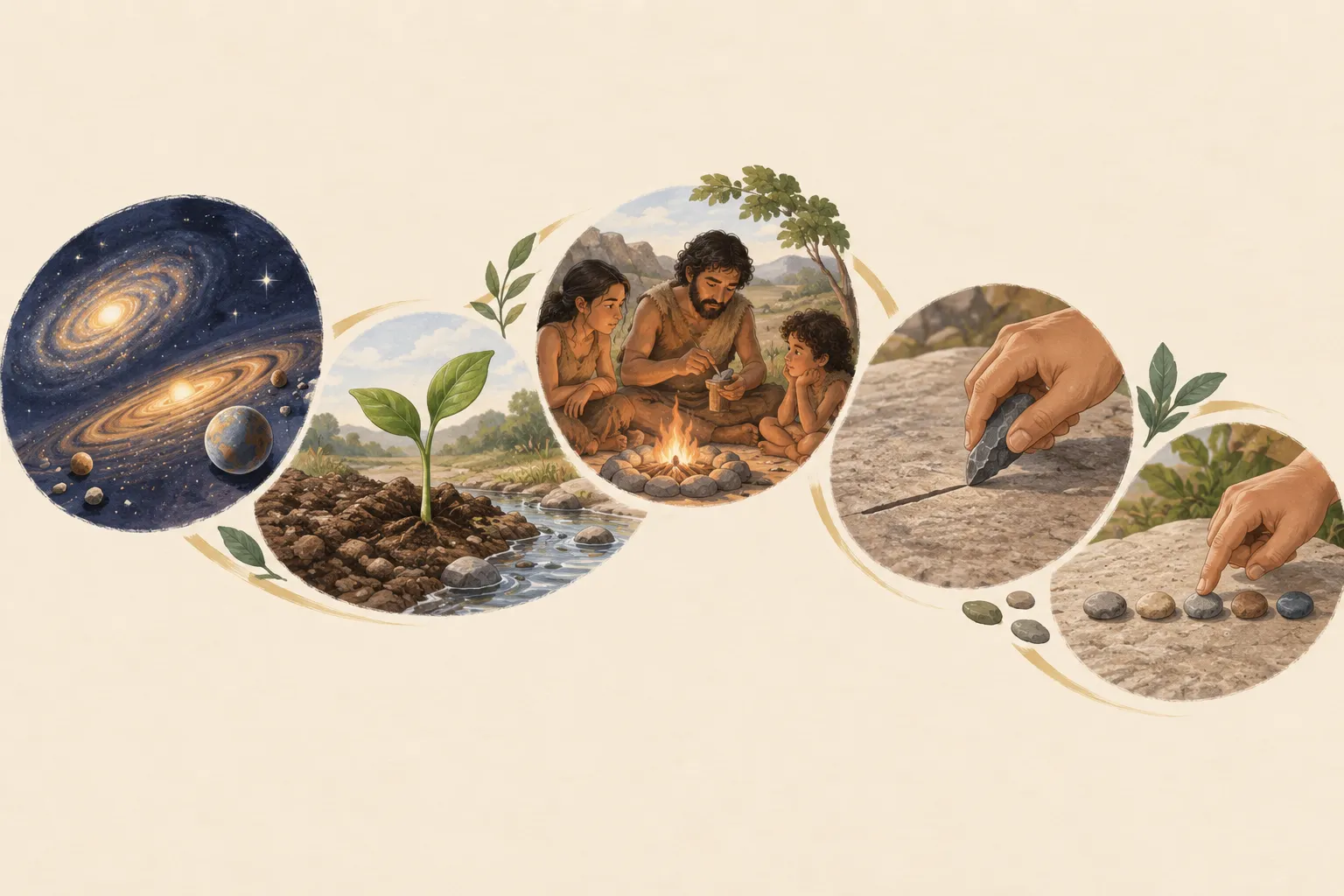
If you go to a Montessori school, have you ever noticed that your classroom has globes and maps, jars with leaves in them, timelines on the wall, letter shapes to trace, and little boxes of beads for counting, all in the same room? That’s not an accident. In Montessori’s approach, the idea is that they are all pieces of one enormous story. Even if you don’t go to a Montessori school, the story is yours too. Here’s how it goes.
Before there was anything to see
A very, very long time ago, so long ago that the number is almost too big to say out loud, there was no Earth, no sun, not even any light the way you know it. Then, little by little, over an unimaginably long time, specks of matter began to pull towards each other, clump together, and heat up, until they formed into great burning balls of light: stars. Our own star, the Sun, was one of them, and the leftover dust and rock spinning around it slowly gathered itself into a small, round, cooling planet. That planet was the Earth, and for a long time it was nothing like the place you live now. No oceans, no air you could breathe, no green anywhere at all.
But slowly, the Earth settled into a kind of order. Rain fell. Oceans filled. Air formed. Everything on Earth, the wind, the rock, the water, seemed to settle into doing its own particular job. It was a bit like an orchestra, where every instrument has its own part to play, even before anyone is there to listen.
The first tiny bit of life
Then something happened that nobody fully understands, even the most careful scientists. Somewhere in that early ocean, the very first living thing appeared. It was tiny, far too small to see without special instruments. But it could do something the rocks and water couldn’t. It could grow, copy itself, and change a little each time it did.
Across an enormous stretch of time, that tiny beginning became millions of different kinds of living things: plants that learned to catch sunlight, creatures that swam, then crawled, then walked, then flew. Each new kind of life added something the Earth hadn’t had before.
Someone new arrives
Eventually, after a truly staggering amount of time had passed, a new kind of creature appeared who was different from everything before: human beings. We weren’t the strongest, or the fastest, or the best hidden. But we had something unusual: hands that could shape tools, and minds that could imagine something before it existed, then try to build it.
Early humans used that gift to do something no other animal had managed quite the same way. They did more than survive in the world as they found it. They started changing it, carefully, on purpose, generation after generation, and they passed on what they’d learned to the next generation instead of starting from nothing each time.
Remembering across time
For a long stretch of human history, everything anyone knew had to be carried inside someone’s memory, or passed on by voice, person to person. That worked, but it was fragile. A story could change in the retelling, or vanish completely if nobody happened to remember it. So, in different places around the world, people began inventing marks that could carry a thought even after the person who made them had gone: writing. A mark on clay, or stone, or bark, could now hold an idea safely across years, because the idea no longer needed someone’s memory to survive. It could wait, written down, until someone else was ready to read it.
Counting what you cannot hold in your head
People also ran into a different problem: how do you keep track of a hundred sheep, or trade fairly with someone, or measure how much grain you have left for winter, when numbers that large are hard to hold in your head all at once? So people invented ways of counting and recording quantity, first with marks and then with symbols, that let a mind that could only easily picture a handful of things at a time keep track of thousands, or millions, without getting lost.
How this story connects to everything you learn
Here’s the part that connects it all back to school. In Montessori’s approach, the idea is that every subject you learn, biology, geography, history, reading, writing, maths, is a closer look at one part of this same enormous story. When you study plants or animals, you’re looking closely at the “life appearing and changing” part. When you study history, you’re looking at the “humans arriving and building” part. When you practise your letters, you’re using the very same kind of invention, marks that carry a thought, that people had to come up with for the first time, long ago. Seen this way, nothing you learn is really separate from anything else you learn: it’s all one story, looked at from different angles.
Why this page exists (for grown-ups reading along): this page is a child-level retelling of the idea behind what Montessori educators call “cosmic education”, which they describe as the organising principle of the 6–12 classroom, where subjects aren’t taught as disconnected blocks but as facets of one continuous narrative: the universe forming, life appearing, humans arriving, and then humans inventing writing and number systems. In many elementary Montessori classrooms this idea is traditionally introduced through five dramatic, impressionistic presentations sometimes called the “Great Lessons” or “Great Stories,” each one opening into months of follow-up work in a particular subject area. The page describes the idea as Montessori educators present it; it makes no claim about its effects.
A note for grown-ups: this page is an original, paraphrased retelling for young readers, inspired by the structure and spirit of the Five Great Lessons used in many 6–12 Montessori classrooms. It does not reproduce the content, wording or presentation of any specific lesson, training material, or published text. For the fuller, educator-facing account, including how the narrative maps onto specific curriculum areas, see Cosmic Education: Curriculum Mapping.
Correction, 11 October 2026: an earlier version of this page said that people invented ways of counting “at around the same time” as writing, and that the reader’s teachers think this is one of the best stories there is, neither of which this site had checked. It also presented the Montessori idea that every subject belongs to one story as a fact about every Montessori classroom. See the corrections log.