Who was Maria Montessori?
For readers aged 6 to 12. An adult may want to read this one with you first. If you are 3 to 6, read it together with an adult.
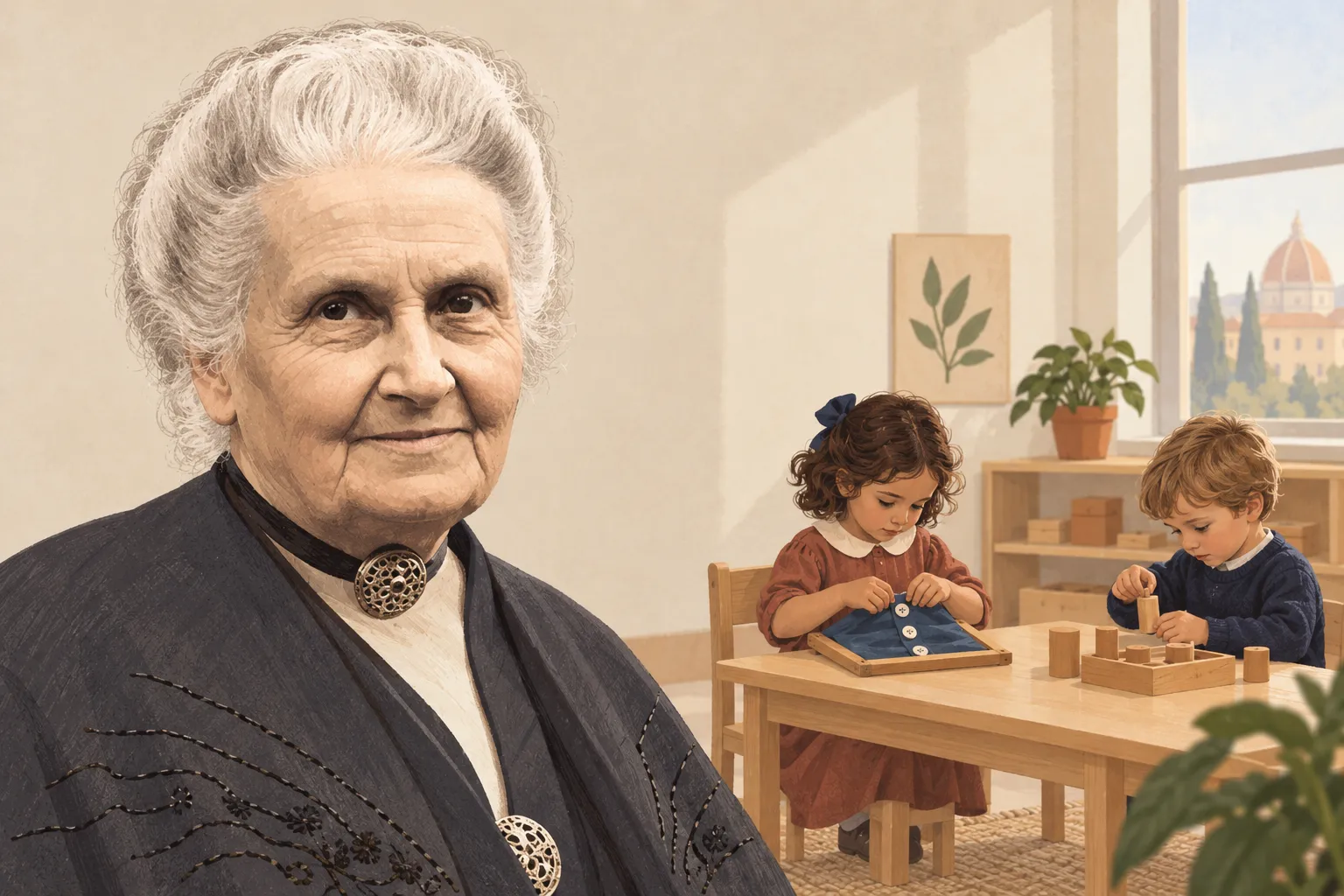
A girl who asked a lot of questions
Maria Montessori was born a very long time ago, in 1870, in a small town in Italy called Chiaravalle. That’s more than 150 years ago! Back then, most girls were not expected to become scientists or doctors. People thought girls should learn to sew and cook and not much else.
Maria didn’t agree. She loved mathematics and she loved asking “why?” So she kept studying, even when people told her to stop, until she became one of the very first women in Italy to become a doctor. That took enormous stubbornness and enormous courage.
A doctor who noticed something strange
As a young doctor, Maria spent time with children who learned differently from other children, and who weren’t being given much chance to learn at all. She noticed something that surprised almost everyone at the time: when she gave these children interesting things to touch and figure out for themselves, instead of being talked at, they concentrated hard. They learned.
She thought: if this works so well for children who were told they couldn’t learn, maybe it would work for every child.
The house for children
In 1907, in a poor neighbourhood of Rome, Maria got the chance to test her idea properly. She was asked to set up a space for young children. She called it the Casa dei Bambini, which means “Children’s House” in Italian.
Instead of making the children sit still and listen all day, she gave them real, interesting things to do: pouring water, buttoning buttons, sorting objects by size and colour. Then she did something almost nobody had tried before. She watched, carefully and quietly, instead of constantly telling the children what to do.
What she saw amazed her. Children who had seemed restless and distracted became deeply focused once they were allowed to choose their own work and finish it at their own pace. They wanted to work and to help. They wanted to try things again until they got them right, all on their own, without anyone forcing them.
An idea that travelled the world
Maria lived until 1952, into her eighties. She spent the rest of her life travelling, writing, and teaching other adults how to set up classrooms the way she had: full of real things to do, arranged so children could reach them, with grown-ups who watched and helped rather than lectured.
Today, more than a hundred years after that first Children’s House in Rome, there are Montessori classrooms in many countries around the world. Many of them are still built around the idea Maria believed in: that children learn best by doing, not by being told.
Something to try yourself
Maria believed that children like doing real jobs all by themselves. Here is one small way to try that at home: pick one job you don’t usually get to do by yourself. Maybe pouring your own drink, setting the table, or caring for a plant. Ask if you can do the whole thing yourself, slowly, without anyone finishing it for you. See how it feels to do it all on your own.
A note for grown-ups: this page is a simplified, original account for young readers, drawn from the biographical facts in this site’s own fuller biography. Where it says what Maria Montessori believed, it describes her ideas, not research findings. No text from Maria Montessori’s own writing is reproduced here.
Correction, 11 October 2026: an earlier version of this page said that Maria Montessori lived “well into her eighties”; she died in 1952, aged 81. It also said that there are Montessori classrooms on every continent, which this site had not checked, and presented some of her beliefs about children as facts. See the corrections log.