Why different ages are together
For readers aged 6 to 12. If you are 3 to 6, read it together with an adult.
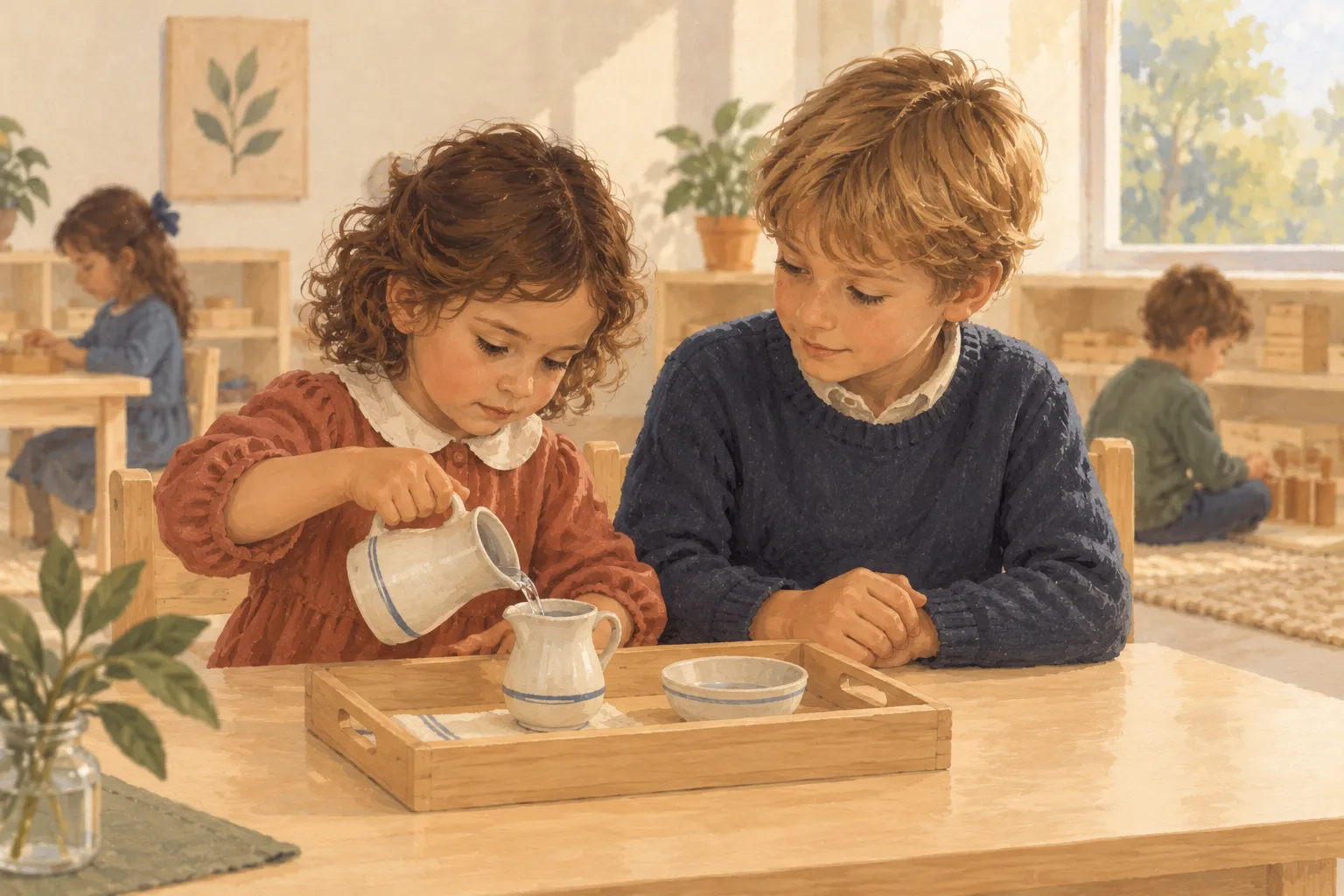
In a lot of schools, everyone in the room is the same age. In a Montessori classroom, that’s usually not true. You might be six, sitting next to someone who’s seven, who’s sitting near someone who turned nine not long ago. That’s done on purpose, not by accident. Here are some of the reasons behind it.
Watching someone a little ahead of you
Imagine you’re four, and you’ve never managed to tie your own shoelaces. Watching a grown-up do it is actually quite hard to learn from. Their hands move fast, and the whole thing feels impossibly far from anything you could do yet. But watching a six-year-old tie their laces, slowly, while sitting right next to you, is different. They’re close enough to your own size and skill that it looks like something you could actually manage soon. Sometimes, not long after watching, you find you can.
That’s one of the quiet reasons behind putting older and younger children in one room. A younger child gets to watch dozens of small examples, all day, of things slightly beyond what they can do yet. Not an impossible leap, but the next step.
Teaching someone else can help you understand it better
Now imagine the other direction. You’re eight, and you already know how to count out beads in groups of ten. A six-year-old asks you to show them how. To explain it, you have to slow right down, notice which part is confusing, and find a way to say it that actually makes sense to someone who doesn’t already know it.
That’s surprisingly hard. But lots of people who’ve taught a younger brother, sister, or friend how to do something notice afterwards that they understood it more clearly than before they explained it. Older children in a Montessori classroom get to do this often, which is part of why, in Montessori’s approach, it’s encouraged rather than treated as a distraction from their own work.
Feeling less like “the slow one”
In a classroom where everyone is exactly the same age, it’s easy to notice if you’re not as fast as everyone else at something, because everyone’s expected to be doing roughly the same thing at roughly the same time. In Montessori’s approach, the hope is that this kind of comparing matters much less in a mixed-age room. Of course a three-year-old can’t yet do what a six-year-old can. That’s not a worry. It’s how growing up goes, and nobody expects otherwise. The idea is that you get to work at your own pace, surrounded by examples of what’s coming next, without it feeling like a race you’re losing.
You get to be the “little one” and then the “big one”
Because Montessori classrooms usually keep the same mixed group together for two or three years, you don’t stay the youngest forever. The child who was once watching someone else tie their shoelaces eventually becomes the one a younger child watches. Being shown something kindly, and later showing someone else the same kindness, is part of the normal rhythm of the room, not a special event, but how the years go.
A note for grown-ups: this page is an original explanation, written for young readers, of the pedagogical reasoning behind Montessori’s mixed-age, multi-year classroom groupings (typically spanning three years, such as ages 3–6 or 6–9); see Understanding the Stages for the fuller account of the age bands this is built on. The reasoning is Montessori’s and Montessori educators’; it is described here, not presented as a research finding. It is not a reproduction of any published text. For what a mixed-age room actually looks like day to day, see A Day in a Montessori Classroom.