Why Montessori classrooms use real things, not toys
For readers aged 6 to 9. If you are 3 to 6, read it together with an adult.
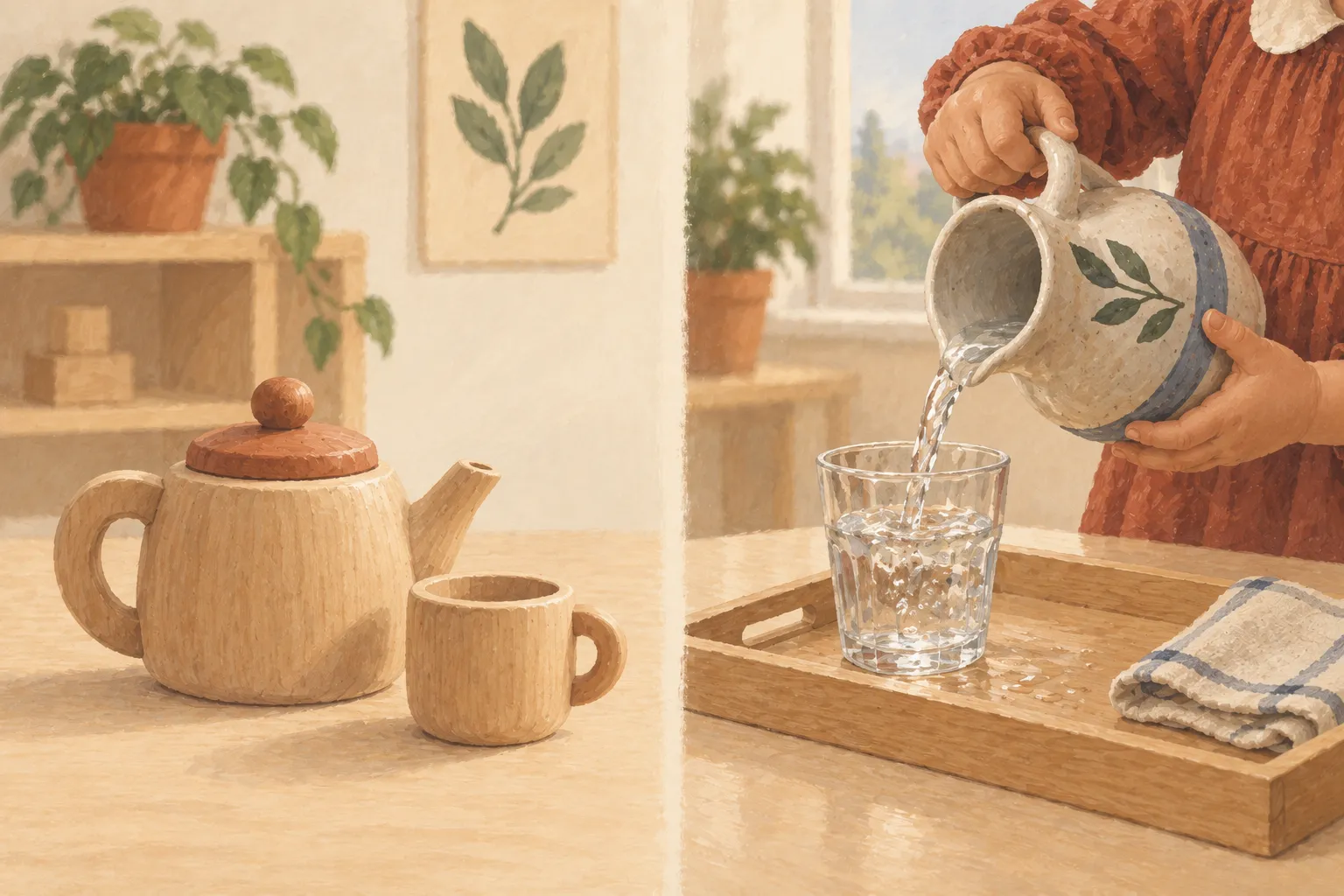
You might have noticed that a lot of Montessori classrooms don’t have many toys that only pretend to do things. Instead, there are real, small versions of real tools: a jug that actually holds water, a broom that actually sweeps, scissors that actually cut. Here’s why Maria Montessori thought real things matter.
A real jug can show you real things
A toy teapot that doesn’t really pour can be fun, but it can’t teach you anything about how water actually moves, how heavy a full cup feels compared to an empty one, or what happens if you tip it too fast. A real small jug can teach you all of that, because it’s real. Your mistakes are real too, and so is getting it right.
Mistakes that show themselves
Lots of Montessori materials are built so that if you get something wrong, you can see it yourself, without anyone telling you. Try the cylinder blocks: each cylinder only fits into one hole. If you pick the wrong one, it won’t go in. Nobody needs to tell you it’s wrong. You can feel and see that it doesn’t fit. That’s on purpose. It means you get to notice your own mistake and try again, as many times as you want, without anyone watching over your shoulder or making you feel bad about it.
One thing at a time
Some materials are designed to let you notice one thing at a time. The Pink Tower is ten cubes that are exactly the same in every way except one: size. Maria Montessori believed that stacking them in order helps your eyes get better and better at judging size, because nothing else is changing to confuse you. Other materials are made for noticing colour, or texture, or weight, one at a time, before you have to juggle several of those at once.
Why this might matter more than it looks
Maria Montessori once described a child working with the cylinder blocks. The child tried again and again, and when every cylinder fitted at last, the child broke into a smile of triumph. In Montessori’s approach, the idea is that moments like this, repeated many times, help build a feeling a lot of grown-ups call confidence. It’s the ordinary feeling of knowing you can figure things out yourself, because you’ve done it again and again.
A note for grown-ups: this is an original explanation written for young readers, describing the reasoning Montessori and Montessori educators give for practical-life and sensorial materials (see Classroom Materials Reference for the adult-level version). It describes their ideas, not research findings, and it is not a reproduction of any published text.